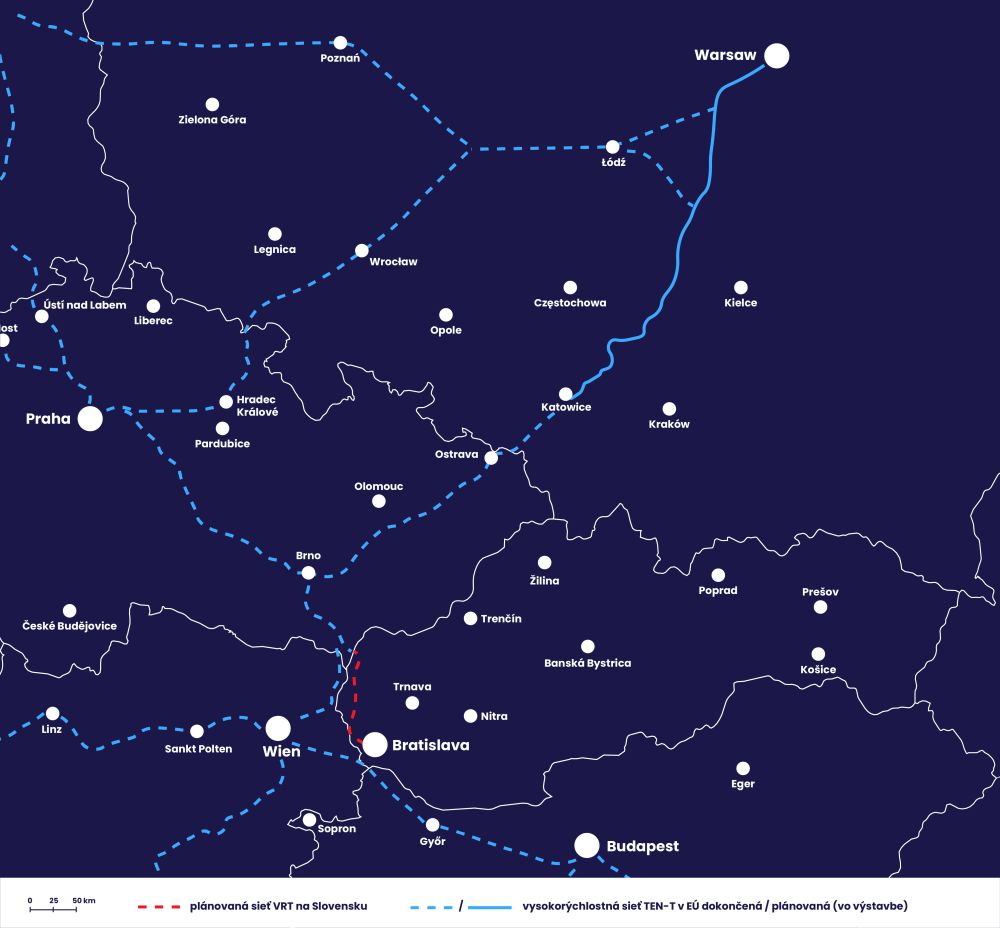
Železnice Slovenskej republiky (ŽSR) has presented the results of the national feasibility study for the VRT V4 high-speed rail project, defining how Slovakia could be integrated into the V4 and Austrian high-speed rail networks, with a focus on routing through the Bratislava railway node.
3 main scenarios
The study evaluated three main scenarios for routing high-speed services through Bratislava: two development options based on new alignments and one conservative option maximising the use of existing infrastructure. Together, the scenarios comprised 38 technical alternatives built from 30 modular sections, which were narrowed down to seven options for detailed cost–benefit analysis.
The two development scenarios envisaged new lines with design speeds of 160–200 km/h, including new crossings of the Danube and the Little Carpathians. ŽSR said these options were not recommended for further preparation due to environmental constraints, spatial limitations, and an unfavourable cost–benefit ratio.
The study identifies a conservative variant as the preferred technical solution. This option combines targeted new construction with systematic capacity upgrades on existing lines, particularly along the southern bank of the Danube, and requires extensive modernisation of the Bratislava rail node.
Construction of a new Bratislava západ station
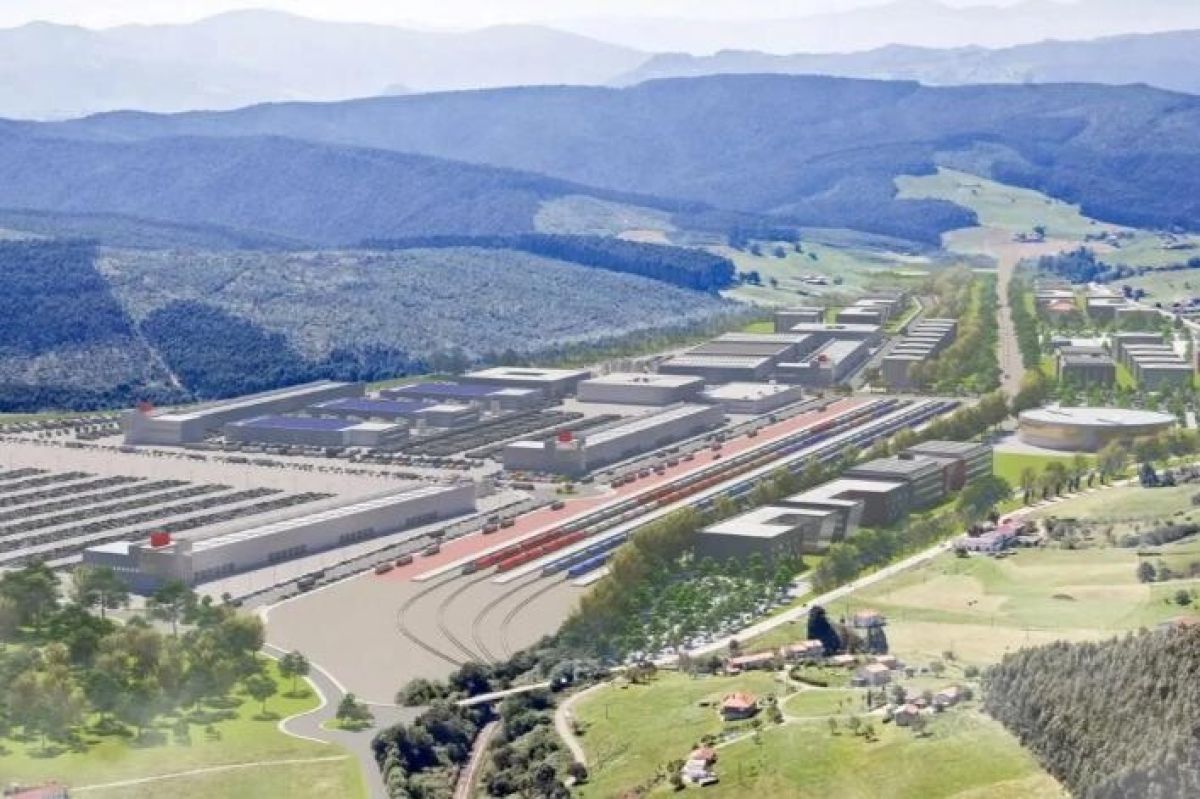
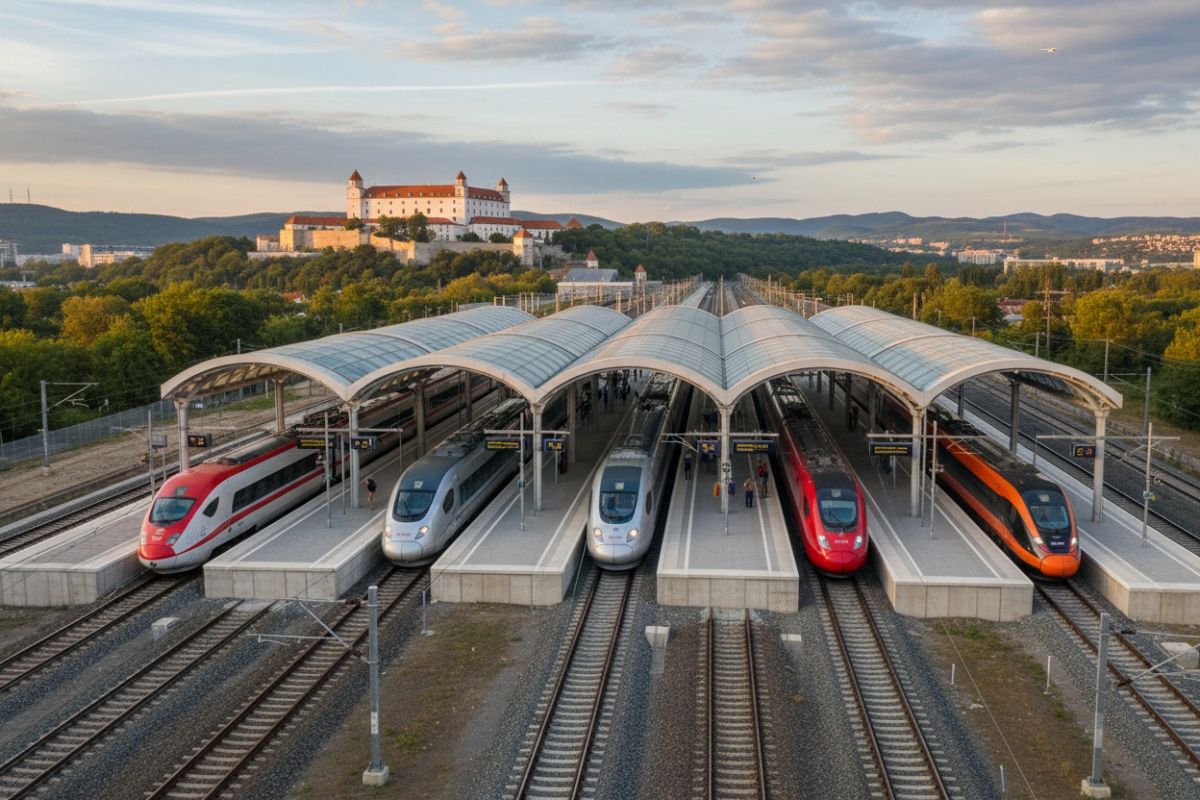
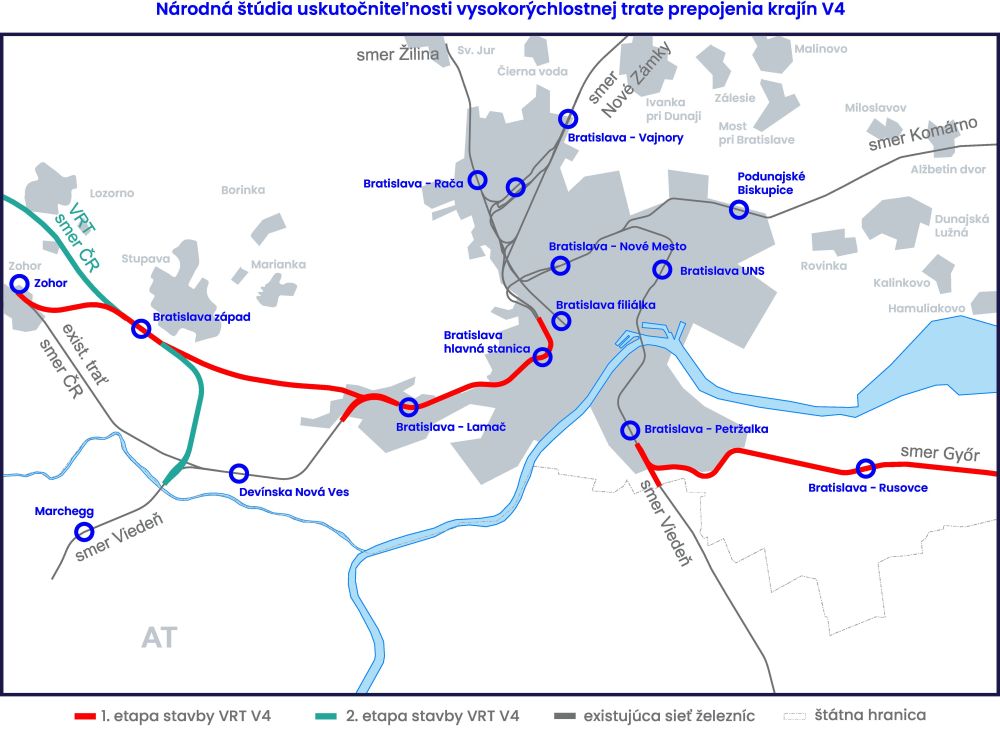
Key elements of the preferred solution include construction of a new Bratislava západ station near Stupava, which would act as the main formation, maintenance and terminal station for domestic services and a stop for high-speed trains. Servicing functions would be relocated from Bratislava hlavná stanica to Bratislava západ to release capacity in the city centre.
Further measures include modernisation of track layouts at Bratislava hlavná stanica, increasing permissible speeds from 30 km/h to 50 km/h and extending tracks to 750 m to accommodate freight trains. A four-track connection between Bratislava hlavná stanica and Lamač is proposed, including a grade-separated junction towards Bratislava západ via a new double-track railway tunnel.
The preferred variant also provides a new Lamač–Bratislava západ–Zohor line running parallel to the D2 motorway with speeds up to 160 km/h, and a new high-speed line from Bratislava západ to the Slovak–Czech border designed for speeds up to 320 km/h. An additional connecting line from the Marchegg route would link services from Vienna and southern Europe to Bratislava západ for high-speed services towards Brno and further north.
Current main station as an intermediate stop
Under the operating concept, Bratislava hlavná stanica would remain in use as an intermediate stop for domestic and international passenger services, including high-speed trains. Freight traffic would not use the new high-speed line, although the study also examined options to increase freight capacity through a potential tunnel bypass of the main station, subject to further simulations.
The project is planned in two stages. The first phase, scheduled for 2030–2040, covers modernisation and expansion of the Bratislava rail node, construction of Bratislava západ station and connections to existing lines. The second phase, with completion targeted between 2046 and 2050, includes construction of the full high-speed line towards the Czech Republic and connections to Austria.
Three billion EUR in costs
Total investment costs for the VRT V4 project, including associated works within the Bratislava node, are estimated at EUR 3.06 bn, excluding additional costs for project preparation and land acquisition.
According to the study, the proposed infrastructure would reduce journey times significantly. Indicative timings include 102 minutes between Budapest Keleti and Bratislava hlavná stanica, 115 minutes to Bratislava západ, and 148 minutes between Budapest and Brno. Travel times of 33 minutes between Bratislava západ and Brno, and 24 minutes between Bratislava západ and Vienna, are also projected, subject to construction of the new high-speed sections.