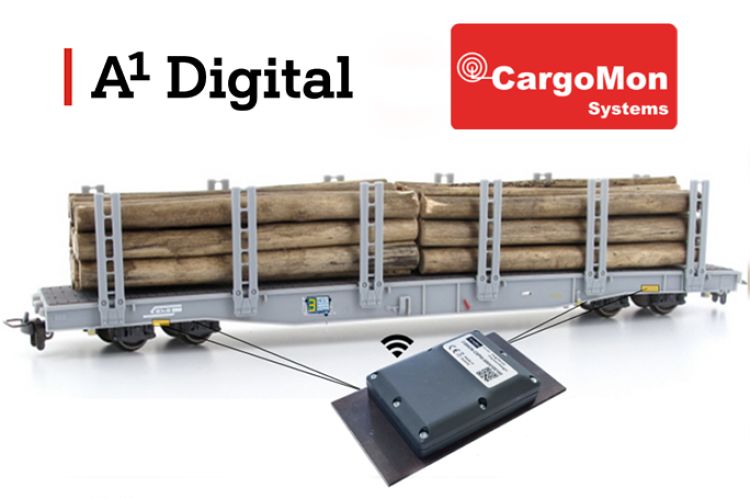
Following the interview focused on A1 Digital’s solution on shock sensors within the telematic solutions provided for rail freight wagon owners, this time, we focus on the new generation of telematic sensors providing improved weight measuring.
For this, a collaborative effort of A1 Digital and Cargomon Systems was established. Railmarket interviewed Jürgen Rudolf, responsible for innovative rail solutions at A1 Digital (JR), and Stefan Mahlknecht, CEO and founder of Cargomon Systems (SM).
A showcase of the technology described in this article can be seen at InnoTrans 2024 Berlin (September 24-27) in hall 21, booth 350 (A1 Digital at Advantage Austria). Moreover, there will be a dedicated event at the Speakers’ Corner (Hub 27, level beta, beta 3-4) on September 24, 3:00 to 4:00 which will also be streamed online.

A1 Digital is well known to our readers. Would you, Stefan, please introduce Cargomon Systems in brief?
SM: Of course. We are the provider of telematic solutions for the rail market. We started in the container and trailers tracking, but in the recent years we've moved more and more into railway. So, in brief, we equip railway cars with our trackers and sensors for telematics.
What were the beginnings of the cooperation of Cargomon Systems and A1 Digital?
SM: It was bringing together the best of both worlds (A1 Digital and Cargomon). The rollout of telematics solutions of almost complete fleet of Rail Cargo Austria led to this deeper cooperation. Then there were two other customers which Cargomon was in touch at the same time as A1 Digital. So, it made sense to join forces to provide a better solution for customers.
What is Cargomon’s part of this?
SM: We are providing the full hardware, which is mounted on the wagons including the firmware and the backend. The backend is basically the counterpart which sits on the surface of the device and collects the data from the sensors and does some additional functionality - like mileage calculation, or, for instance, the weighing solution. We add the individual sensors together to get to a total weight and we analyze it.
From the point of view of the shock sensors, customers benefit and save money by knowing when and where the improper handling occurred. What initiated the need for weight measurement of wagons?
JR: The early beginnings of weight measurement of wagons have been very inaccurate. What was measured was the distance from the chassis to the track. Once you loaded the cargo the difference was around 35 mm per full loading. If we translate to one or two tons, the difference was only around 1 mm – a very difficult one to measure on large objects such as wagons. These results were not good enough for some quality-sensitive customers, such as Rail Cargo Austria.
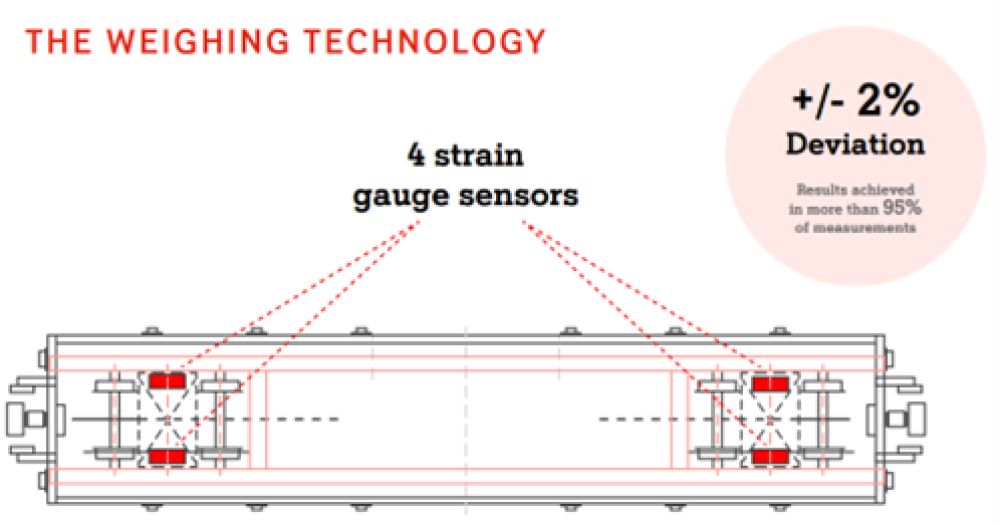
The main challenge was to avoid overloading and uneven loading and, at the same time, use the loading capacity of wagons to the maximum. 5-10% deviation was not enough. The benchmark was rather like 2% or less. And this is what we bring. A wireless solution that measures weight with this high precision.
How does this wireless solution work if not based on chassis-bogie measurement?
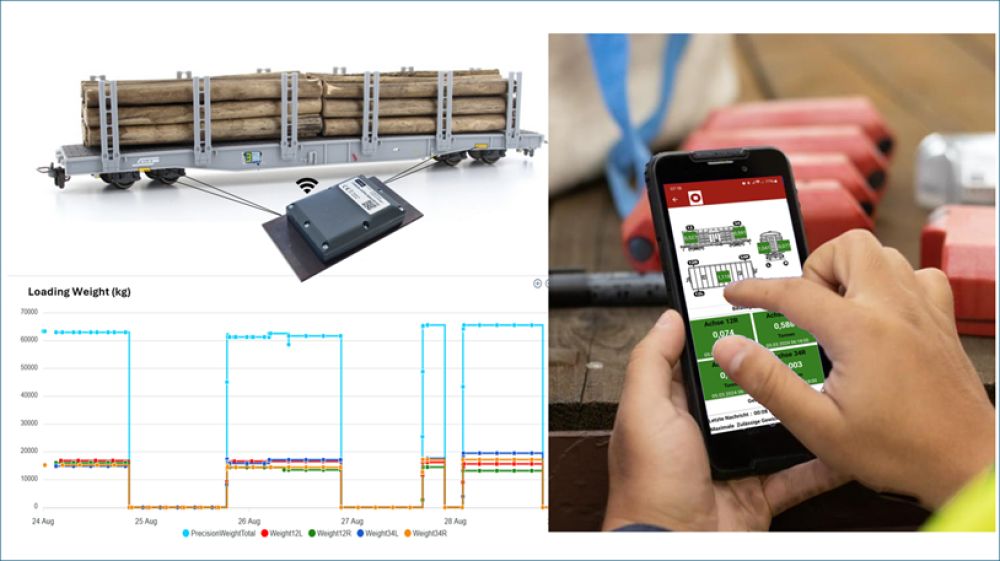
SM: It is based on measuring the bending of the steel frame of the bogie, and the bending is an indicator of the change in weight. There is always some stress in the steel structure of the bogie and when you load, the stress gets bigger. And this difference in bending of steel, even a tiny fraction of change in weight, is measured by strain gauge sensors. These are small sensor elements which measure the change in pressure or strain.
What is the benefit for the customer?
SM: The benefit for the customer and the one who is loading the wagon is that they can load more precisely, getting very close towards 100% loading potential without overloading. Today, as carriers want to avoid overloading and forced sidetracking of wagons for unloading in stations due to detection on dynamic weighing stations, they make sure there is less cargo loaded to avoid this situation. But that does not utilize the wagon to maximum, just up to 90%.
With our device, the loader can turn on an app that is connected via Bluetooth to the device on the wagon. Within seconds, let’s say the loader of logs sees, if he can load one or two more logs, how much potential there is still to get as close to 100% wagon weight utilization as possible.
Simply put: You are able to carry more per wagon. You need less wagons for the same amount of freight. This is the simplest and most effective cost saving method because instead of 20 wagons you need, for example, only 18 per train.
JR: As Stefan mentioned, the greatest fear of the loader is to be sidelined due to overload, because this is extremely expensive. Another thing is that, thanks to this functionality on our devices, we can detect uneven load of weight, which can be fixed immediately during loading. This saves damage and wear and tear of wagons, which results in lower maintenance costs for the wagons owner.
You have mentioned round wood as a good example of cargo for this weight measuring solution. What other commodities come to your mind?
SM: It is ideal for bulk cargo. You can quite precisely measure a weight of a car, container, or semi-trailer by other methods. But loading of logs, scrap, or bulk material like grain, aggregates like stone, ores – these are the primary target commodities for wagons with weight measuring telematics solution installed.
Where are the weight measuring sensors installed and how do they work together with A1 Digital’s Rail Insight solution?
SM: The sensors are installed, from one to four, on each wagon, depending on what you want to measure. These sensors are Bluetooth based and connected to the main telematic solution which acts as a gateway to the cloud.
JR: As mentioned, we call our end-to-end telematics solution Rail Insight. It provides the excellent hardware from Cargomon, the connectivity, the IoT platform, data analytics, AI machine learning, project management, customer support and all other administrative matters associated with the telematics solution installed on the wagon.
Is it possible to add the weight measuring device of Cargamon and connect it via Bluetooth for an existing customer as an upgrade to more basic telematics solution?
JR: For our devices, yes. Weight measuring, as it was mentioned, is not necessary for every wagon. Some types of wagon need, for example, a temperature sensor to monitor if the cooling chain is not broken or disrupted, and so on. It pretty much is about listening to the needs of customers and we can, based on our experience, recommend the telematics solution that would enhance their operation.
So, let's say I have a Cargomon device already installed on my wagon. How much time and efforts does it take to to install the additional weight measuring device?
SM: The wagon must go to the to the repair shop. It's difficult to do it in the field because you must weld. For the overall timing, it can take between one and two hours to have the entire wagon equipped for weight measuring sensors. This is because you must prepare the area so that you can weld and after seal the device. So, it's a few steps and you have 4 sensors and not just one, so it takes a bit longer.

What is your main message regarding your Rail Insight Solution to new customers?
JR: I think it is worth mentioning that tracking and tracing are nearly a standard today in freight wagons. But all the operators and wagon owners should check their solutions. Many of the existing solutions are now in the face of ending the first lifecycle. It is good for customers to ask themselves: Do I still want to just track and trace, or do I want to save money by having less damage on wagons and earn more by having wagons better utilized to their maximum potential weight? That is what we are trying to advocate esp. following our philosophy: digitalization of rail wagons without any wire, using all interfaces via BLE (Bluetooth low energy) which will be the future standard in railway sensor community. There are immediately deployable digital solutions for freight rail that can save your costs and make more money by using things more wisely – just by the collection, processing data, AI and IoT.
SM: I fully agree. It is the right time now to switch to a second generation of telematics solutions where we add a lot of new sensors possibilities and customers can start making freight rail smarter.
What's in the pipeline in the future?
JR: As said before, we will be exhibiting at InnoTrans 2024 in Berlin and will also host an event focused on weight measurement and balanced load on September 24, from 3:00 to 4:00.
Beyond that, also together with Cargomon, we are working on more precise detection of flat spots on the wheelsets. I think it's an important topic, as more and more customers are asking, not only whether there is a flat spot, but asking the very relevant questions: Why did it happen and when? And we want, once again, to deliver answers.