Lithuania’s Ministry of Transport and Communications and LTG Group have examined Spain’s variable-gauge railway technology as part of ongoing assessments of potential connections to the Rail Baltica standard-gauge network. The discussions took place during a May meeting in Madrid with Spanish infrastructure manager Adif and rolling stock manufacturer Talgo.
The Lithuanian delegation reviewed Spain’s dual-gauge model, which combines Iberian-gauge (1,668 mm) and European standard-gauge (1,435 mm) infrastructure, as well as interoperability between conventional and high-speed lines. Spain has used variable-gauge systems to allow trains to operate across both networks without requiring passengers to transfer.
At the gauge-changing facilities, the locking mechanism is released, the wheels shift to the required gauge and then re-lock. The process takes several minutes and is carried out without stopping the train.
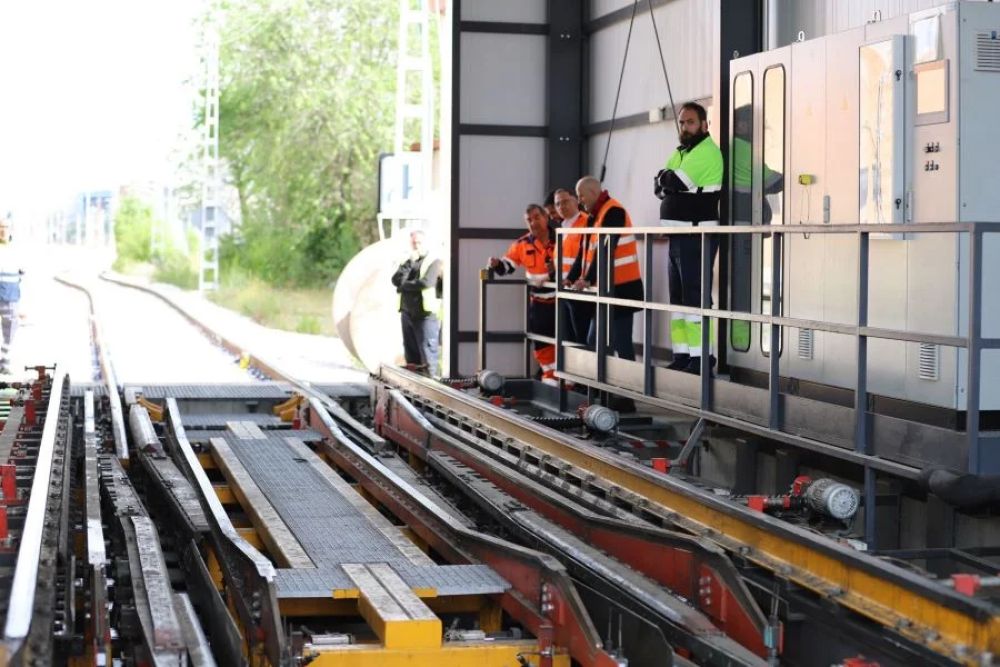
Spain developed the system while expanding its standard-gauge high-speed network alongside the legacy Iberian-gauge network. According to the Lithuanian side, variable-gauge installations can be dismantled and relocated once new standard-gauge sections are completed, allowing phased network expansion without permanent transitional infrastructure.
Spain’s rail network totals nearly 16,000 km of Iberian and standard-gauge lines. Around 60% of passenger services use variable-gauge solutions. The country’s high-speed fleet includes approximately 90 trains equipped for gauge-changing operation, with plans to increase this to around 120 trains.
Lithuania is assessing technical options to improve connections between Vilnius and the future Rail Baltica main line. The ministry states that no decision has been taken on specific technologies or suppliers and that alternatives will be evaluated based on cost, interoperability and long-term transport policy objectives.
Rail Baltica will provide an electrified 1,435 mm railway linking Lithuania, Latvia and Estonia with Central and Western Europe. The project is being advanced ahead of negotiations on the 2028–2034 EU Multiannual Financial Framework, where political and financial backing will be sought.