As road infrastructure in Africa continues to present challenges, CEVA is increasingly incorporating rail into its multimodal transport strategies. At the same time, the company has successfully executed a complex international project in Canada, transporting oversized railcars from China, further showcasing the potential of rail freight for handling large-scale, high-value cargo.
Rail freight expansion in Africa
Africa’s logistical landscape is heavily reliant on road transport, with approximately 80% of freight moved by trucks. However, road infrastructure in many parts of the continent remains underdeveloped, with only 27% of roads paved. This leads to frequent overloading of trucks, deteriorating road conditions, and a reliance on congested routes. These issues have driven logistics providers like CEVA to explore alternative solutions, with rail freight emerging as a more efficient and sustainable option in specific regions.
CEVA, which had a presence in only five African countries in 2019, has expanded its operations significantly. The company now operates in nearly 25 countries, with a reach that spans over 40, supporting regional and international trade across key corridors. CEVA’s focus is on connecting landlocked African countries to critical regional ports using a combination of road and rail transport.
Block train from Mozambique to Zimbabwe
A major example of CEVA's efforts in this area is the recent operation of a full block train from Mozambique’s Cornelder Port to Harare, Zimbabwe. The block train transported cargo for more than 10 customers across 341 miles (549 kilometers), utilizing the railway network to bypass congested roadways. This move highlights the potential of rail for cross-border freight transport in Africa, where road infrastructure struggles to keep up with growing demand.
Rail freight, though still underused in Africa, offers several advantages, particularly in reducing carbon emissions and lowering transportation costs. CEVA’s block train operation, carried out in cooperation with local authorities and the CFM railway in Mozambique, demonstrates the viability of rail as a strategic alternative for regional freight transport. However, the continent’s rail networks face challenges of their own, with only about 70% of rail infrastructure fully operational. Despite these limitations, rail remains an important tool in addressing Africa’s logistical needs.
Energy equipment transport in Tanzania
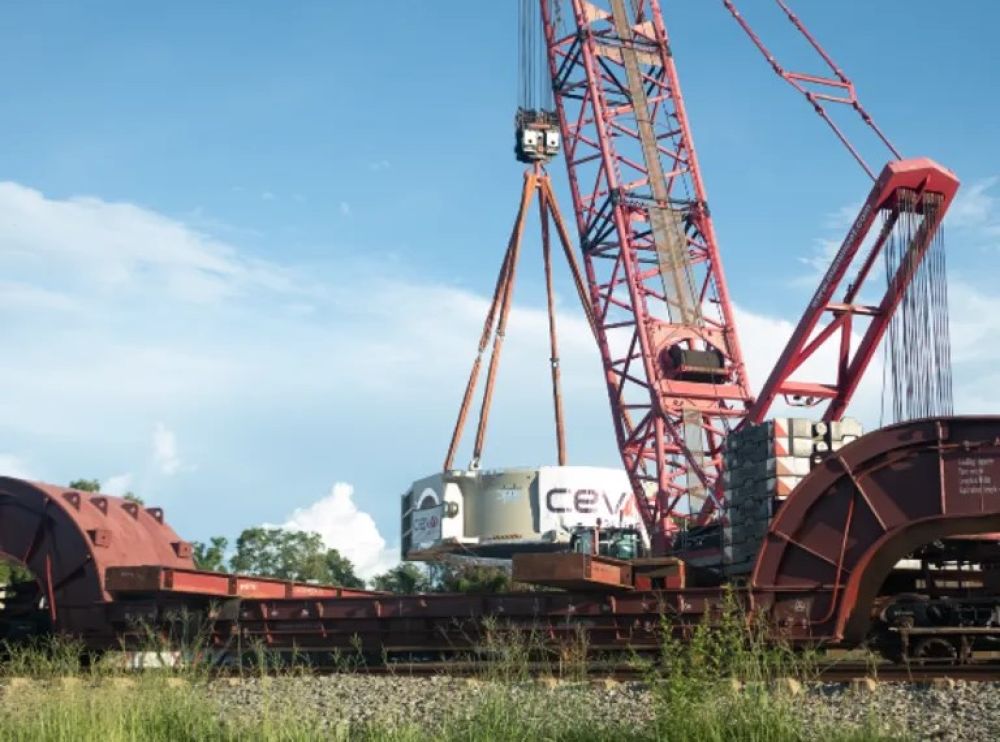
CEVA also recently handled the transport of sensitive electrical transformers for a hydropower plant in Tanzania. The oversized and fragile equipment required a hybrid solution of both road and rail transport. CEVA's engineering team developed a detailed plan to ensure the safe delivery of the transformers, which included rehabilitating sections of the railway and implementing shock monitors to minimize vibration during transit.
The journey involved transporting the transformers from Tanzania’s Port of Dar es Salaam by road to Mzenga train station, covering 106 miles (170 kilometers). From there, the transformers traveled 75 miles (120 kilometers) by rail to the Fuga rail station. To ensure the transformers were protected throughout the journey, CEVA utilized custom-designed rubber friction mats to absorb movement and shock during transport.
Rail freight solutions in Canada: Transporting new railcars from China
In Nort America, CEVA managed the complex transportation of five 62-ton double-deck railcars from Tianjin, China, to Montreal, Canada. The oversized railcars required a multimodal approach, involving land, sea, and rail transport to cover a total distance of over 12,200 kilometers.
The railcars were moved from the CRRC Tangshan factory in Tianjin to Tianjin Port, where they were loaded onto a cargo ship for a journey through the Panama Canal to Quebec’s Bécancour Port. From there, the railcars were transferred onto rail tracks for the final leg of the journey to the project site in Montreal.
Each railcar, measuring 27 meters in length and weighing more than 62 tons, posed significant logistical challenges. CEVA’s technical teams designed specialized packaging and securing methods to protect the railcars during ocean and rail transport, ensuring their safe arrival at the project site.