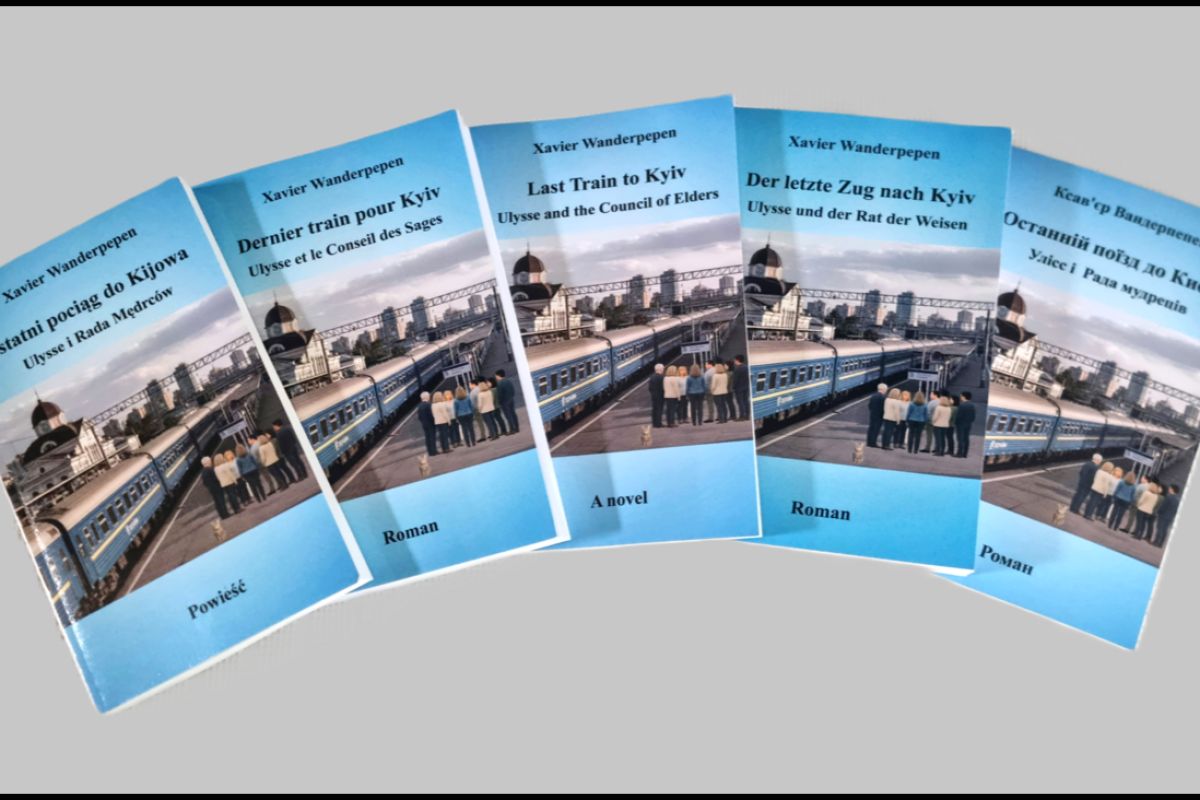
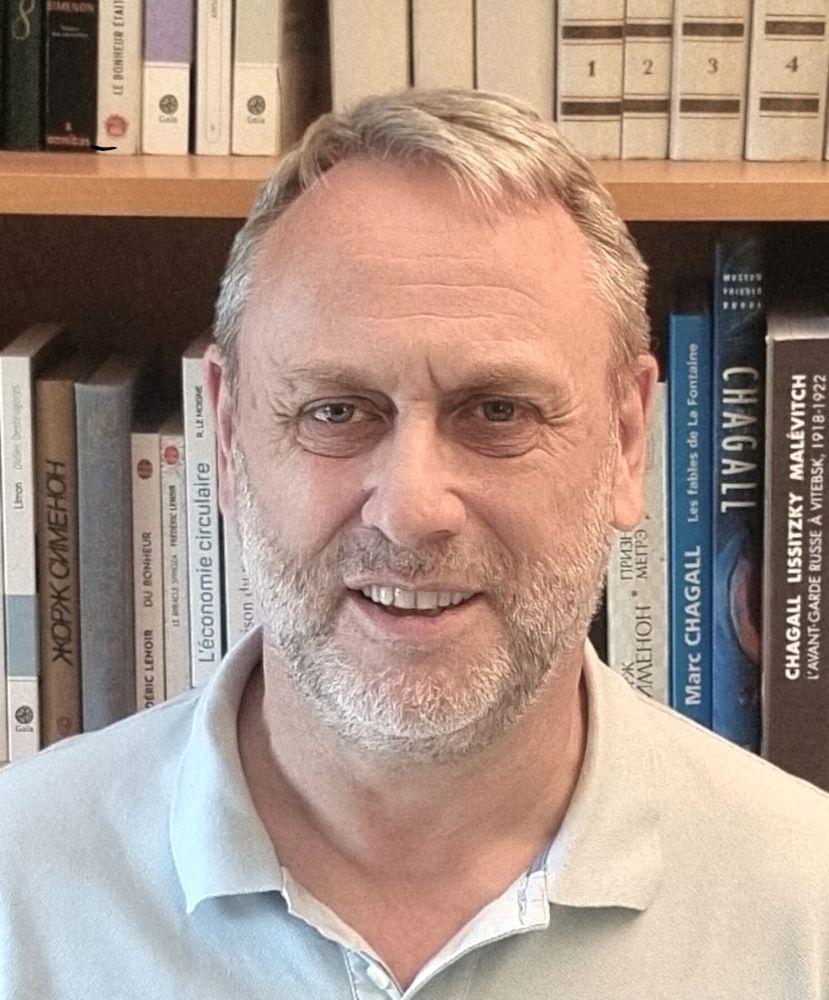
Xavier Wanderpepen, the author was born in 1963. The Last Train to Kyiv is his first novel. A man of many interests, he worked for 40 years at SNCF, Fret SNCF, Captrain and Forwardis in the field of international rail transport. His book, available in several languages, is on sale on the major online retail platforms.
RM: You spent decades at SNCF leading freight rail projects — from transporting cattle from France to Russia, to the Silk Road rail links connecting Paris with China. Looking back, which project do you consider the most defining of your career, and why?
For me, the most memorable project was organising the transport of car parts from France to Russia. It was Russia's industrial integration into European economies. I think it was a win-win model, and it is symptomatic that it all came to an end because of the Kremlin's belligerent ideology.
RM: In the novel, Ulysse is described as someone who devoted his life to “building bridges between people and countries.” How autobiographical is this character? Where does Ulysse end and Xavier begin?
I can say that the first chapter describing the trains is entirely autobiographical. The characters' names are pseudonyms referring to my colleagues at the time. I can even say that the journeys, the discussions with our colleagues from Poland and elsewhere, and the descriptions of the meals correspond exactly to what I experienced.
From the second chapter onwards, I added fictional elements, as I was not in Ukraine during the war, but like all Europeans, we lived through those moments vicariously. This part shifts from autobiography to autofiction. However, many things are real: all the places, the cities of Odessa and Kremenchuk, the Helocopter Hotel are places I knew well.
I wanted to move away from the real experiences of my colleagues and myself, and therefore from an adventure novel, to move towards a more geopolitical novel in which I offer reflections and introspection. So I can say that it is Xavier who appears in the first chapter, and that Ulysses and his melancholy seem to give the story perspective and imagination. But ultimately, Xavier and Ulysses form a duo.
RM: As an engineer you spent your career working with specifications, gauges and technical standards. At what point did you decide these experiences needed to become a novel rather than a memoir or a professional report? What does fiction allow you to say that facts alone cannot?
Before writing this novel, I had written summary notes on procedures and project cycle management as part of my consulting work. All of this amounted to nearly two hundred pages. And I realised that what was important to me was this rather unique story. And even more so, an observation about Russia: ‘All that for this, what a waste for Europe and even more so for the Russian people.’
So, almost secretly, I wanted to turn it into a souvenir album and a book of reflections that would be useful to all readers in the world of logistics, and ultimately, I think these reflections are useful to all readers.
RM: They say the best books about railways are written by those who spent years inside them. What does a railway novelist know that a journalist or historian does not?
It is easier for an expert to talk about a subject than for an observer, even a very competent one. For example, in the book, two subchapters are important to me in terms of railway expertise: ‘The Odessa Seminar’ – this type of narrative is never found in any other book, and I think I have succeeded in explaining some very technical issues. Similarly, ‘The Promise of Trains’ is, in a way, a critique of European railways.
RM: The novel is built around five real freight rail projects — including the Vesoul–Kaluga corridor and wagon construction in Ukraine. Why the novel format over a non-fiction book? What does narrative give you that a case study cannot?
A novel allowed me to introduce ideas, debates and a point of view. The narrative draws on quotes and reflections from renowned intellectuals throughout history, such as Churchill, Montesquieu, Nietzsche and others. A fictional narrative allowed me to approach our trains and our history from a geopolitical and perhaps slightly philosophical angle. I could not have done this with a more traditional research report.
RM: One of the pivotal moments is 24 February 2022 — the day of Russia’s invasion of Ukraine. Your protagonists are caught in Kremenchuk at that very moment. Is this literary licence, or were you drawing from a real experience?
This is a work of fiction; I was not in Ukraine on 24 February 2022. But I know this city well, the KVSZ factory that builds railway carriages, the Helicopter Hotel. So it was easy for me to situate the scenes described in this city at the time of the war. For the descriptions of the war, I read numerous newspaper articles, spoke to friends in Ukraine and, like all of us, watched television 20 hours a day when the war broke out.
RM: “The Kremenchuk Process” — an ethic of thought built on responsibility, integrity and critical thinking — is the intellectual core of the novel. Did this framework grow out of your experience managing international teams, or out of your reflection on the war?
In my youth, I studied psychology, theatre and directing. I returned to the fields of study that fascinated me in my youth to analyse a question that remains incomprehensible to me: why are so many Russians and so many populist voters in Europe so uncritical of Putin, and sometimes even support him? Krementchuk's process is a way of explaining, using six criteria, the thought processes of our brains. But please note, I am not a psychologist; this is merely a writer's proposal.
RM: Volodia is the character who “understands Russia” and attempts to defend its choices — yet ultimately overcomes his nostalgia. Was it difficult to write this character with genuine sympathy while the war is still ongoing?
The character of Zhao is one of my Chinese colleagues, under a pseudonym of course. Volodia is imaginary, he's not a colleague. But he fits the profile of people I know, people I've met. I wanted someone who would contradict the other characters in discussions, someone who thinks like Putin's supporters, so that I could have a debate in the novel.
RM: In the novel, the railway network is not merely technical infrastructure — it becomes a metaphor for European integration and its fragility. Does the story of rail connectivity say something that politicians cannot?
It is true that railways are linked to European integration. But as we know, European railways are capable of both, the best and the worst when it comes to passenger and freight trains. To answer your question, what politicians cannot say is that, unlike air transport, rail integration does not really exist. Our infrastructure networks remain too dependent on the systems of the past. In 2022, governments realised that allocating train paths for military trains could take up to 40 days. This is a real problem for European defence. This is just one example among many.
RM: Your career spanned an era when European rail freight seemed to be on the rise — the Single European Railway Area, interoperability, the Silk Road. Where, in your view, did that ambition go wrong?
We know that rail freight has suffered from a lack of investment and that track management, traffic management and even wagons are 10 to 20 years behind in terms of innovation. I address these issues in the two subchapters entitled “The promise of trains” and “The new Europe and reconstruction”. For the European Union, excessive competition and free trade are the solution to everything, but for trains, as for other sectors, this is a mistake. For rail freight, the result is that systematic competition can compromise profitability, limit investment and reduce service quality. Liberalisation of the sector fragments the market, dispersing customers and volumes among numerous operators, when what is needed is consolidation. In rail freight, the competitors are not really lorries, but other railway companies, which is an aberration. What was needed was regulated liberalisation, closer to the model used by local freight operators or regional passenger trains, whose volumes of activity are not targeted by other rail competitors. In the words of Nobel Prize-winning economist Philippe Aghion, ‘planning without competition is a sure way to create unproductive rents. Competition without such planning risks allowing short-termism to prevail’. European railways fall into the second category.
My opinion about the Silk Roads, this is a fairly insignificant issue, a niche that is only useful to a few customers. Or an adjustment variable when other modes of transport are experiencing difficulties. And today it suffers from an operating model in which the system without train paths and capacity reservations creates random delays, leading to excessive and too frequent delays. The Silk Roads by rail have failed in their challenge.
RM: French rail freight is among the most criticised in Europe — chronic market share losses, the crisis of single-wagonload traffic. The novel does not look away from this. What should SNCF Fret have done differently?
There are many reasons, but the two main problems facing French rail freight over the last 30 years have been the deindustrialisation of France and the priority given to high-speed trains. Trains involve very high fixed costs, so hundreds of thousands of tonnes of potential are needed to make them profitable. As a result, some regions with too little potential are markets for lorries rather than trains, and we should not regret this. The issue of single wagons has been well managed, in my opinion, by Fret SNCF since the 2000s, and many countries have taken inspiration from this model. I think Fret SNCF did its best given the complex situation. Looking back, I would say that the reforms were implemented too late. But that would probably take a whole book to explain properly.
RM: The Vesoul–Kaluga corridor — nearly a thousand trains carrying automotive parts over five years — is a compelling example of what rail freight can achieve at scale. Why are such projects so difficult to replicate today?
If your question concerns trade with Russia, it should be addressed to the Kremlin. I would say that Russia has prioritised ideology and war over the interests of its people and its economy. I wrote the subchapter ‘Russian Economy’ in an attempt to understand Russia's economic situation. It will not be possible to develop again these trains, as trust in Russia has been broken for a long time. Companies that take risks do not want to lose their investments again, and Russia is not such an important market.
RM: Railmarket.com covers the whole of Europe, from the Atlantic to the Carpathians. Where do you see the greatest untapped potential in European freight rail over the next decade?
It seems to me that developing combined transport is a priority, putting lorries on trains, and that would require a genuine European plan to meet this challenge. The difficulty lies in the fact that all this has to be planned over 10, 20 or more years. And it requires billions. Unfortunately, the world is forcing Europe to spend more on defence than on its infrastructure.
RM: The novel was published first in French. And now in other languages, what prompted you to translate it, and who is the reader you have in mind?
Yes, we are publishing the English, German, Polish and Ukrainian edition. I think this novel is a subject that goes far beyond the French-speaking world, and many of my acquaintances in Europe have asked me for access to an edition in their language. A German rail freight forwarders told me, ‘We are going to give this book to our new employees because it is an excellent introduction to freight trains and the issues they face, and it is also a training manual for our professions.’ A few weeks after its publication in France, readers who are unfamiliar with the railway world told me that it was a real discovery. The book is not intended solely for railway specialists, but for a wider audience seeking discovery and analysis.
RM: The rail industry community is global but does not always read fiction. What do you want a reader from the sector — a logistics manager, a transport engineer, a regulator — to take away from Last Train to Kiev?
Readers should understand that Last Train to Kyiv tells the story of the transition from an old world governed by trade and rules, with its trains, to a world where some want to apply the law of the strongest.
The SNCF engineers and their friends, the elders of Kementchouk, talk about the world and talk about all of us. And when all is said and done... so many questions about geopolitics, trade and economics remain. What remains of the hopes of the book's heroes? These trains are affected by economics, geopolitics and history. A broader question arises: what future do we want to build in an unstable world? In the face of geopolitical shocks, environmental constraints and social tensions, adaptation becomes a necessity, not a choice. This book invites us to look at globalisation without naivety, but without giving up hope.
The nicest compliment a reader ever gave me was this: ultimately, this book is not just the story of Ulysses, it is the story of all of us, it tells us about our lives.
RM: The reconstruction of Ukraine’s railway network is shaping up to be one of the largest infrastructure opportunities of this decade. What does your novel say about what we need to get right this time?
It is indeed a real challenge, but Ukraine has significant industrial potential and a well-educated population. Investment in reconstruction is already considerable, and Ukraine will be the most attractive country in Europe. That is its strength. You know, countries undergoing reconstruction, such as the former GDR, Poland and all the others, have experienced decades of growth. This is the future that awaits Ukraine once peace is restored. The Ukrainian network faces a particular challenge in terms of interoperability with its European neighbours due to its different track gauge. I am following with great interest the Spanish project for Ukraine concerning variable gauge freight wagons. I am convinced that this will provide effective and inexpensive solutions, compatible with the reconstruction of certain 1,435 mm gauge lines.
I would add that, as far as trains in Ukraine are concerned, I hope they will not apply the methods we are familiar with in Europe. Closing unprofitable lines and treating liberalisation as a religion. A model combining the public and private sectors will have to be found, because trains are not just a cost and a selling price, they are also what keeps people and certain businesses alive. Ukraine and Europe will have to reinvent their economic models.
In New Europe and Rebuild, Ulysses considers that economic models lack fairness for the people. This means that everything rests on two pillars: the characteristics of a product or service and its price. However, there is nothing new here, but we know that three pillars are missing: social, societal and environmental costs. Europe and Ukraine will have to embark on reconstruction with a new model. This is undoubtedly a utopia, but it is a hope. I think the United States and China would also find reasons to accept this hope. Nothing is more desperate than new reasons for hope, as Machiavelli wrote.
RM: You dedicated the novel to your son Antoine with the epigraph: “Balance must triumph over excess — that is the whole history of humanity.” What do you hope he takes from this book?
That populism and its simplistic ideas “just do this, just do that” are not the solution. That to be free, you have to be feared, and to be feared, you have to be powerful. It all depends on our economic models, which have reached the end of a cycle. We must now rethink economic systems at the level of Europe and its main partners, the United States and China, in order to make them more equitable. This means taking better account of social, societal and environmental costs. Balance must triumph over excess, which means that as soon as the dominant have too much power over the dominated, the world becomes sick. This is the whole history of humanity.